




Aktuelle News & Schlagzeilen
Louis Philippson on tour with Neumann MCM microphones and Sennheiser Spectera
Classical pianist Louis Philippson first drew attention to himself when he was just seven years old with a YouTube video of his performance during a talent competition. Born in 2003, Philippson, who has synaesthesia, has since become a social media phenomenon with more than 1.3 million followers and is seen as one of the most successful classical music influencers.
On Philippson’s current “Classical Music for Everyone” tour, Neumann Miniature Clip Mic MCM systems reproduce the performance of the artist and his ensemble. The microphone signals are transmitted wirelessly via the Sennheiser Spectera wideband ecosystem.
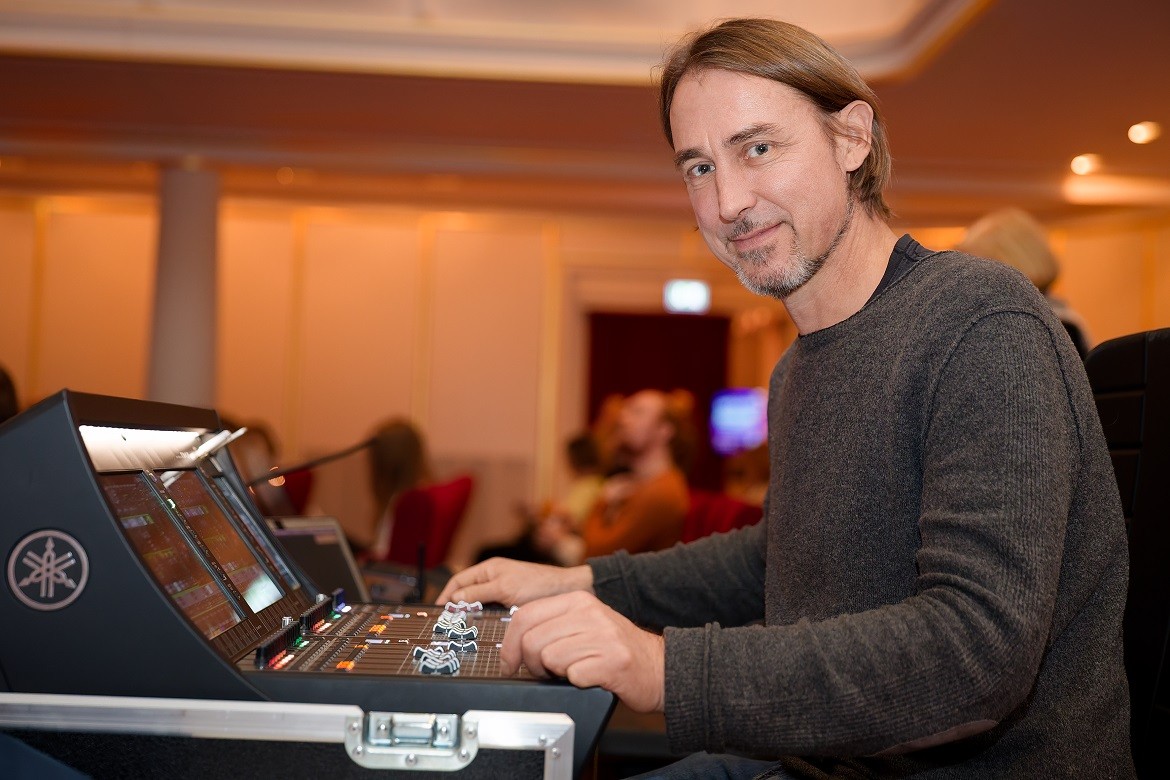
Six Spectera SEK bodypacks are used to transmit the microphone signals on this tour. Front-of-house engineer Thorsten Seeliger (pictured) places two packs on padded mats in the grand piano, and a further four are used by the Berlin Chamber Collective (first and second violins, viola, cello), who accompany the pianist. For wireless transmission to the Spectera Base Station, Seeliger has selected the “Raw Low Latency” audio mode. The Base Station uses an 8 MHz wide UHF channel. Seeliger keeps the second available 8 MHz channel free as part of his emergency back-up concept.
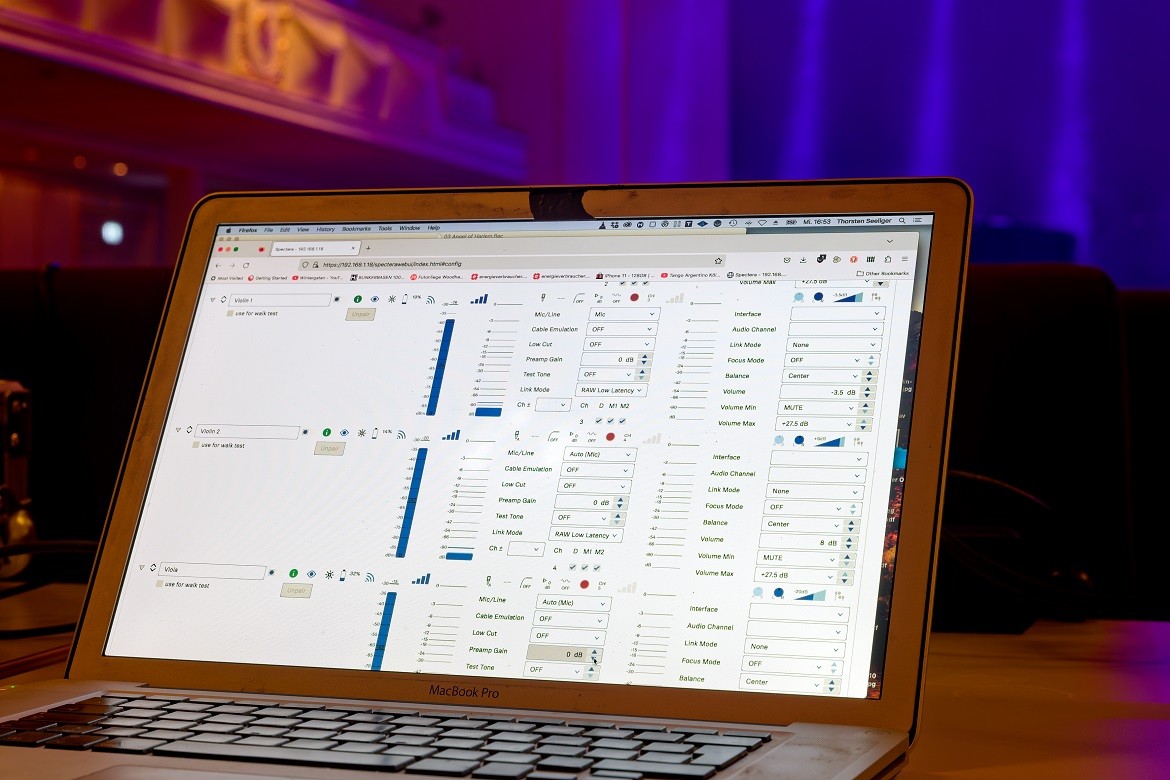
Two DAD antennas are connected to the Spectera Base Station using network cables. They are supplied with power by PoE and are placed on stands on the right and left of the stage. The Base Station is connected to the digital mixing console via Dante. Sennheiser Spectera WebUI running on a laptop at the FoH console provides an overview and remote control options. The BA 70 lithium-ion battery packs for the SEK beltpacks are recharged in a Sennheiser L 6000 charging station.
For miking the grand piano, Seeliger employs the Neumann MCM 114 Stereo Set Piano, using Neumann MC 8 Magnetic Piano Clips to direct the capsules at the tenor and treble strings in an AB arrangement. The Neumann microphones are supplemented by a dynamic Sennheiser Evolution E 904 instrument microphone mounted at the tip of the piano above the bass strings. The first and second violins and the viola each use a Neumann MCM 114 Set High Strings (MC 1), while the cello is miked with a Neumann MCM 114 Set Cello (MC 2). To address the audience, Philippson uses a Sennheiser SKM 500 G4-S handheld transmitter with an MMK 965-1 capsule and an EM 300-500 G4 True Diversity receiver. A further G4 handheld transmitter with an MMD 935-1 capsule is used as a talkback microphone.
One of the responsibilities of the experienced audio professional at Nordlite Event Solutions GmbH is distributing Spectera. He has been accompanying Louis Philippson since the autumn of 2024, initially as his tour manager and now, during the current “Classical Music for Everyone” tour, in his dual role as chief sound engineer and tour manager.
“This combined use of Neumann MCM microphones and the Sennheiser Spectera wideband wireless system on the ‘Classical Music for Everyone’ tour is something new for me, although I’ve owned the MCM sets for quite some time now and I use them regularly”, says Seeliger. “The SEK bodypacks are bidirectional, which means that they can transmit mic/line signals and receive IEM signals simultaneously. However, conventional wedges are employed as monitors on Louis Philippson’s tour, as the young ensemble is not yet experienced in the use of in-ear systems. I’ve found that many classically trained musicians tend to view in-ear monitoring with some scepticism at first, as they are accustomed to purely acoustic listening environments. I can fully understand that the ensemble didn’t want to start using IEMs in concerts straight away without having had time to get used to it.”
The use of wedges on stage was the reason why Seeliger selected KK 14 capsules with a cardioid pick-up pattern rather than the omnidirectional Neumann KK 13 model. By doing so, he wanted to avoid crosstalk between the microphones and prevent potential feedback. The ensemble had no objections to attaching the MCM clips to their instruments, and Louis Philippson also had no concerns about having microphones and bodypack transmitters placed in his piano.
“During most of the concert, I only make subtle use of mixing the signal from the Sennheiser E 904 on the bass strings of the piano with the two Neumann MCM microphones”, Seeliger reveals. “However, the programme also includes a piece by AC/DC, and for this I can use the E 904 to provide the low-end ‘punch’ that is needed.” To make the sound as clean and transparent as possible, he deliberately avoided using miking set-ups that are commonly favoured in classical music contexts, such as small- or large-diaphragm microphones arranged at some distance from the instruments.
As for frequency management, Seeliger says: “It’s become really easy. I carry out a scan once at the venue, select a free area, enter the values and, in a workflow that takes about fifteen seconds, I’m ‘set and done’. The bodypacks are also automatically set to the correct frequency range without any input from me. And I no longer have to bother with putting tape on the bodypacks to mark the user’s name.”
(Photos: Sennheiser)
SCHLAGZEILEN
news archiv
suche
© 1999 - 2026 Entertainment Technology Press Limited News Stories